The AI That Remembers: Why The Company Of The Future Will Be Small, Smart, And Hard To Beat
Why the company of the future will be small, smart, and hard to beat.
Most people use AI like this. They dump a bunch of files into it. They ask a question. The AI digs through every file, every single time, and patches an answer together.
Think about how dumb that is.
It’s like hiring the smartest assistant on earth, and telling her she’s not allowed to take notes. Every Monday she walks in and re-reads every binder on the shelf before she can help you. Every Monday. Forever.
That’s how 99% of businesses use AI right now.
There’s a much better way. And it changes what a company even looks like.
Let the AI take notes.
You let the AI read your stuff once. Then it writes its own notes. Its own summaries. Its own connections. “This idea in the sales playbook matches this idea in the training manual.” “These two SOPs say opposite things, weird.”
Now when you ask a question, the AI doesn’t re-read the whole library. It reads its notes.
That’s it. That’s the whole thing.
Ask yourself these questions.
Forget the tech for a minute. Just answer these honestly.
- How long does it take to onboard a new hire? Two months? Three? Six? What if it took two weeks?
- How many times a week do you answer the same question for a client or team member? Twenty? Fifty? What if you never answered it again, and they got a better answer faster?
- How long does it take to write a proposal from scratch? Four hours? A full day? What if it took twenty minutes, and it actually sounded like you wrote it?
- How much of your week is spent hunting for something? An old email. A contract clause. The spreadsheet someone sent three months ago. The SOP you swear you wrote last year. What if you just asked, and got it?
- If your best employee quit tomorrow, how much would walk out the door with them? What if none of it did?
This is the gap. It is not small.
What this actually looks like in your business.
Let me get specific. Because “AI can take notes” sounds small until you see what it actually changes.
Agency owners
You’ve got years of client work. Pitch decks. Strategy memos. Calls. Slack threads. Post-mortems. Every time you bring on a new account manager, you’re basically starting from scratch. They don’t know what worked for Client A. They don’t know why you stopped doing the thing you used to do.
Now your AI knows all of it. A new hire asks: “What’s our playbook for a SaaS client under $2M ARR?” They get a real answer. Pulled from your actual history. In your voice.
Hiring stops being a six-month ramp. It becomes a two-week one. One bad hire costs you $30K to $60K. One fast, good hire recovers that much in the first quarter.
Software companies
Your engineers spend roughly 30% of their time hunting for context. “How did we solve this last time?” “Who touched this module?” “Why did we pick Postgres over Mongo in 2023?”
The answers exist. In Jira. In old PRs. In a Slack thread from 2024. Nobody can find them. Your AI can. It reads the history once, writes its notes, and from then on every engineer has the collective memory of the whole company at their fingertips.
Coaches and consultants
You have courses. Frameworks. Tools. Client calls. Slack messages. Journaling prompts. Years of material, most of it sitting in a local or Google Drive, unused.
Now you build a client-facing tool trained on your method. Not ChatGPT’s generic advice. Yours. A client asks a question at 9 pm on a Tuesday. They get an answer in your voice, built from your frameworks, pointing to the exact module in your program.
That used to cost you an hour of your time. Now it costs zero. And it scales to a thousand clients the same way it scales to ten.
Small businesses
Restaurant. Dental office. Law firm. Contractor. Whatever.
Here’s the honest version. You are the bottleneck. You know how everything works. Nobody else does. When you’re sick, things slow down. When you go on vacation, things break. When you try to sell the business someday, the buyer realizes half the value is locked inside your head.
An AI that reads your SOPs, your emails, your training videos, your client notes, and then answers questions the way you would, is not a productivity tool. It’s succession planning. It’s sellability. It’s you getting weekends back.
Who this is for.
We work with founders doing between $500K and $5M in revenue, with teams of 3 to 25 people. Tech founders. Agency owners. Coaches scaling past their own capacity. People building exciting businesses who have hit the ceiling that talent and hustle alone can’t break through.
These founders don’t need another tool. They need an AI scaling partner who understands that technology is only half the equation. The other half is leadership, systems thinking, and the behavioral shift required to actually let go of the bottleneck.
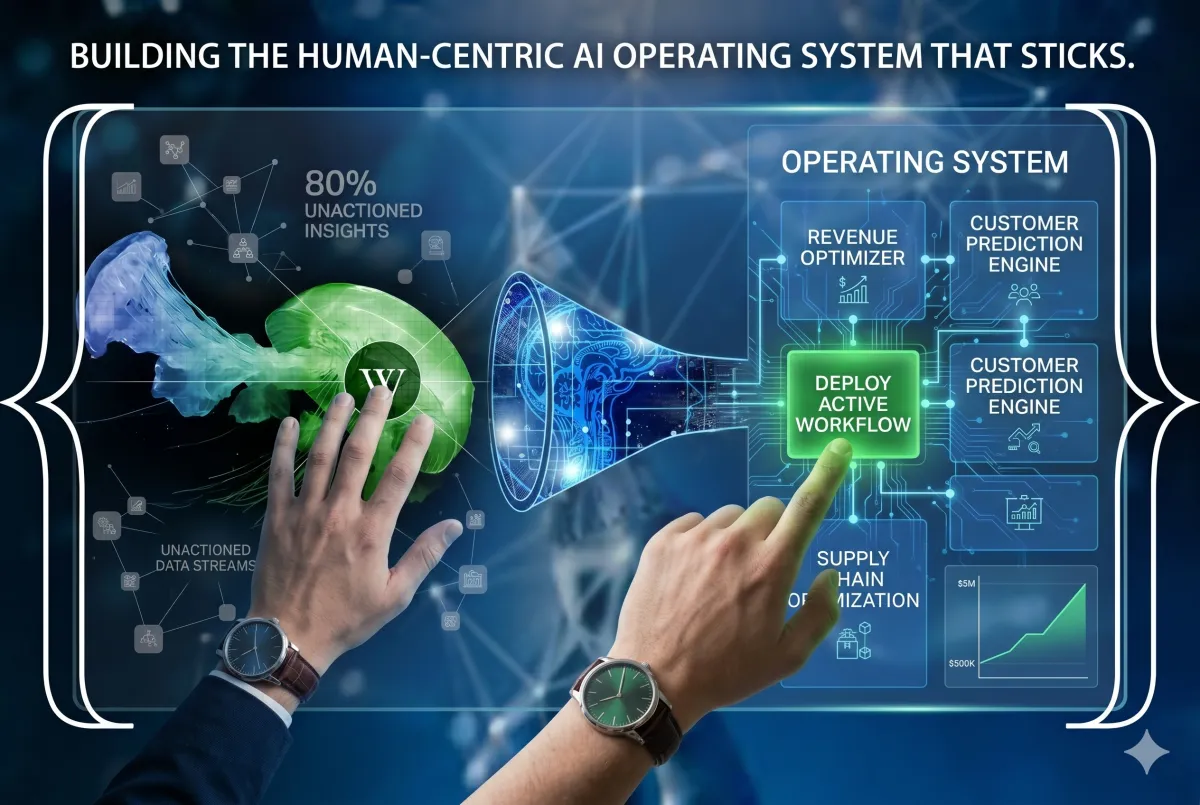
Gartner says 80% of analytics insights will not deliver business outcomes. The tool wasn’t the problem. The behavior was.
That statistic tells you everything. Companies buy software, build dashboards, install automations—and nothing changes. Because nobody addressed the identity shift underneath. The founder who says “I need to review every proposal before it goes out” doesn’t have a technology problem. They have a leadership pattern that no automation can fix on its own.
This is what makes our approach different. We don’t just build the AI layer. We work on the behavioral and identity shift at the same time. The founder who used to be the human router for every decision learns to trust the system. The team that used to wait for approval learns to move. The AI handles the boring stuff—the context retrieval, the first drafts, the pattern matching—so the humans can do the work that actually requires judgment.
This is a fit if you’re:
- A tech founder or agency owner doing $500K–$5M in revenue
- Managing a team of 3–25 people
- Sensing that something internal is blocking your growth
- Ready to look at both leadership and systems—not just buy another tool
- Looking for a partner, not a course
We’re probably not the right fit if you want to learn to build AI systems yourself, or if you’re looking for someone to drop off a Notion doc and disappear. There are excellent communities and courses for the self-build path, and we’ll happily point you to them.
What we do is install an AI operating system in your business while simultaneously coaching the leadership shift that makes it stick. The technology automates the boring stuff. The coaching ensures you actually use it. That’s the combination that most people skip, and it’s why most AI implementations fail within six months.
What we actually do.
Four steps. Repeatable. Predictable.
- Diagnose. Two weeks. We map your business, your workflows, your bottlenecks. We interview your frontline people, not just you. We figure out where AI actually moves the needle, and where it would be a distraction. You walk out of those two weeks with a document showing exactly where the leverage is. Dollar figures. Hours saved. Ranked by impact. Even if you never hire us again, you have a real plan.
- Design. We pick the one or two workflows that matter most and map the fix. What data feeds the system. What rules govern it. What success looks like in 60 days.
- Deploy. We build it. We install it. We train your team on it. We don’t hand you a Notion doc and wish you luck.
- Optimize. Monthly. We tune it, expand it, and add the next workflow. Because one workflow is a win. Five workflows is a transformed company.
The company of the future.
Here’s what we think happens next.
The agency of the future is five people. Not fifty.
The software company of the future ships what a 30-person team ships today, with five engineers, a designer, and a CEO who has expert-level knowledge in a specific area.
The coaching business of the future serves 500 clients with one coach and a built system.
Not because the work got smaller. Because the overhead did.
Every role that exists today to move information around. Project coordinators, junior analysts, tier-one support, SDRs reading from scripts, admins retyping things from one system into another. Those roles are getting collapsed into workflows. Steadily. Quarter by quarter.
The CEO-driven company with an AI workforce is not a sci-fi scenario. It’s what’s already being built by the operators who caught on 18 months before everyone else.
The question isn’t whether this is coming. It’s whether you’ll be running the small team that eats the big agency’s lunch.
Let’s see if there’s a fit.
A free 30-minute conversation. No pitch. No pressure. You tell us where your business is stuck. We tell you honestly whether we think we can help, and roughly what it would look like. If it’s not a fit, we’ll say so and point you somewhere better.
Book My 30-Min Diagnostic Call → If we don’t find at least $25K of annual leverage, it’s free.